
India’s automobile industry entered 2026 on a strong note, supported by improving consumer demand, policy reforms, rural recovery, technological innovation and increasing adoption of electric vehicles. The two-wheeler segment remains at the heart of India’s automotive market, serving millions of consumers across urban, semi-urban and rural markets.
According to the Society of Indian Automobile Manufacturers (SIAM), India recorded its highest-ever domestic automobile sales performance in FY2025-26. Two-wheeler sales reached approximately 2.17 crore units , representing 10.7% growth over FY2024-25.
As India moves through FY2026-27, the industry is entering a new phase where affordability, premiumisation, electric mobility, exports and digital technology are expected to shape the next cycle of growth.
Strong Growth in India’s Two-Wheeler Market
Two-wheelers continue to dominate India's automobile market because of their affordability, fuel efficiency and suitability for India's diverse road and traffic conditions.
SIAM reported that domestic two-wheeler sales reached 21.7 million units in FY2025-26 , surpassing the previous peak recorded in FY2019. Two-wheeler exports also increased significantly, reaching around 5.18 million units , up 23.4% year over year.
The growth demonstrates that India is not only a large consumer market but is also becoming an increasingly important manufacturing and export hub for motorcycles and scooters.
2026 Two-Wheeler Industry Outlook
Industry forecasts remain positive, although growth is expected to moderate from the exceptionally strong performance of FY2025-26.
ICRA expects domestic two-wheeler wholesale volumes to grow approximately 3–5% in FY2026-27 , with replacement demand, improved affordability and the festive season supporting the market. However, weaker rural demand and potential vehicle price increases could limit the pace of expansion.
CRISIL has a more optimistic view, projecting overall two-wheeler volumes to grow 7–9% in FY2027 , taking industry volumes beyond the 29-million-unit level when domestic sales and exports are considered.
The difference between forecasts highlights an important point: India's automobile market has strong structural growth potential, but the actual pace will depend on rural income, interest rates, commodity prices, consumer confidence and export conditions.
Electric Two-Wheelers Are Becoming Mainstream
Electric mobility is one of the biggest structural changes taking place in India's automotive industry.
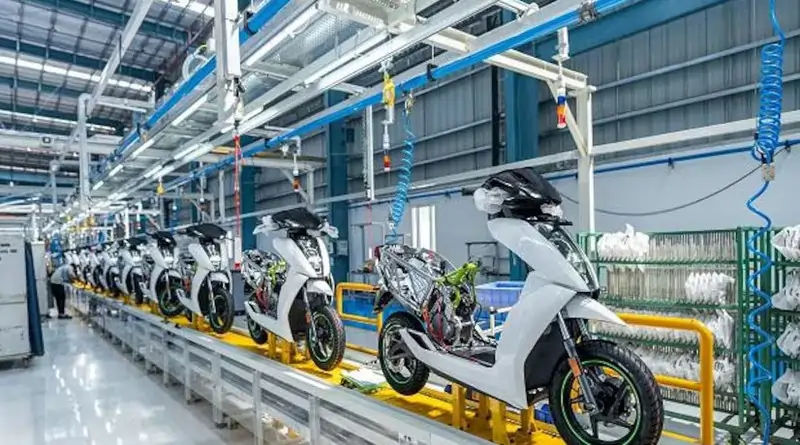
Electric two-wheeler adoption has increased as consumers become more comfortable with EV technology, charging infrastructure improves and manufacturers introduce products across different price segments.
ICRA reported that electric two-wheeler penetration increased to 9.3% during the first five months of FY2026-27 , compared with 6.5% in FY2025-26. Electric scooter penetration reached 22.8% during the same period.
India's broader EV market is also expanding rapidly. IBEF reports that EV sales increased approximately 30% in FY2026 to 2.66 million units, with two- and three-wheelers representing nearly 87% of EV volumes.
This creates opportunities not only for vehicle manufacturers but also for battery companies, charging infrastructure providers, software companies, component manufacturers and EV service businesses.
Premiumisation Is Reshaping the Market
The Indian two-wheeler customer is becoming more sophisticated.
While commuter motorcycles remain essential for mass-market mobility, demand for premium motorcycles, connected scooters, performance-oriented vehicles and feature-rich models is increasing.
Consumers increasingly consider:
- Connected vehicle technology
- Digital instrument clusters
- Advanced safety features
- Better design and styling
- Smartphone integration
- Navigation
- Higher performance
- Electric powertrains
Premiumisation can improve manufacturer profitability because higher-value products generally provide better margins than entry-level vehicles.
Rural Demand Remains Critical
Rural India continues to be an important driver of two-wheeler demand.
Motorcycles and scooters are widely used for commuting, agricultural activities, small businesses and transportation in rural and semi-urban regions. Therefore, farm income, monsoon conditions, employment and rural credit availability can significantly influence two-wheeler sales.
The outlook is not completely risk-free. India's 2026 monsoon season has created concerns for rural demand, and recent industry data showed pressure on some rural-oriented vehicle categories.
Manufacturers will therefore need to balance urban premium demand with affordable products designed for rural and semi-urban customers.
Exports Offer a Major Growth Opportunity
Exports are becoming increasingly important for Indian automobile manufacturers.
India has developed a strong manufacturing ecosystem consisting of vehicle manufacturers, component suppliers, engineering companies and logistics networks.
The two-wheeler export market is particularly promising because Indian manufacturers can serve emerging markets in Asia, Africa, Latin America and other regions with competitively priced motorcycles and scooters.
FY2025-26 two-wheeler exports reached approximately 5.18 million units , growing 23.4% year over year.
Continued investment in quality, localization, product development and international distribution could strengthen India's position as a global two-wheeler manufacturing hub.
Key Challenges Facing the Industry
Despite the positive outlook, India's automobile industry faces several challenges.
1. Commodity Prices
Steel, aluminium, battery materials and other components can significantly affect manufacturing costs.
2. Rural Demand Volatility
Weak monsoons, lower farm income or higher inflation can reduce rural purchasing power.
3. EV Transition
Manufacturers must invest heavily in batteries, software, electronics, charging ecosystems and new manufacturing capabilities.
4. Global Economic Uncertainty
Currency movements, trade restrictions, shipping costs and geopolitical tensions can affect exports and supply chains.
5. Increasing Competition
Indian consumers have more choices than ever, forcing manufacturers to compete on technology, pricing, design, quality and after-sales service.
Opportunities for Businesses in the Automotive Ecosystem
The automobile industry's growth is creating opportunities beyond vehicle manufacturing.
Businesses can explore opportunities in:
- EV charging infrastructure
- Battery technology
- Auto components
- Vehicle software
- Connected mobility
- Automotive ecommerce
- Spare-parts marketplaces
- Digital dealerships
- Vehicle financing technology
- Fleet management
- Automotive SaaS
- Repair and service platforms
- Used-vehicle marketplaces
Digital transformation will be particularly important as manufacturers, dealers and component suppliers increasingly move sales, customer support and service operations online.
What to Expect From India's Automobile Industry in 2026
The Indian automobile industry is likely to remain one of the country's most important manufacturing and consumption sectors.
FY2025-26 demonstrated strong momentum, with domestic sales reaching record levels across major vehicle categories. SIAM expects the positive momentum to continue into FY2026-27, although it has highlighted risks related to crude oil, commodity prices, exchange rates and geopolitical developments.
For two-wheelers, the central themes will be affordability, electric mobility, premiumisation, rural demand, exports and technology .
The winners in this next phase will likely be companies that can combine competitive pricing with innovation, strong distribution, reliable after-sales service and a deep understanding of changing consumer expectations.
Conclusion
India's automobile and two-wheeler industry enters 2026 with strong fundamentals and significant long-term opportunities. Record FY2025-26 sales, rising exports and increasing EV adoption demonstrate the scale of India's automotive ecosystem.
However, growth will not be automatic. Manufacturers must navigate rural demand fluctuations, commodity costs, global uncertainty, technological disruption and intensifying competition.
For businesses operating across manufacturing, dealerships, components, EVs, technology and automotive services, 2026 could represent an important period of transformation.
India is not simply becoming a larger automobile market—it is increasingly positioning itself as a global automotive manufacturing, technology and export hub .