
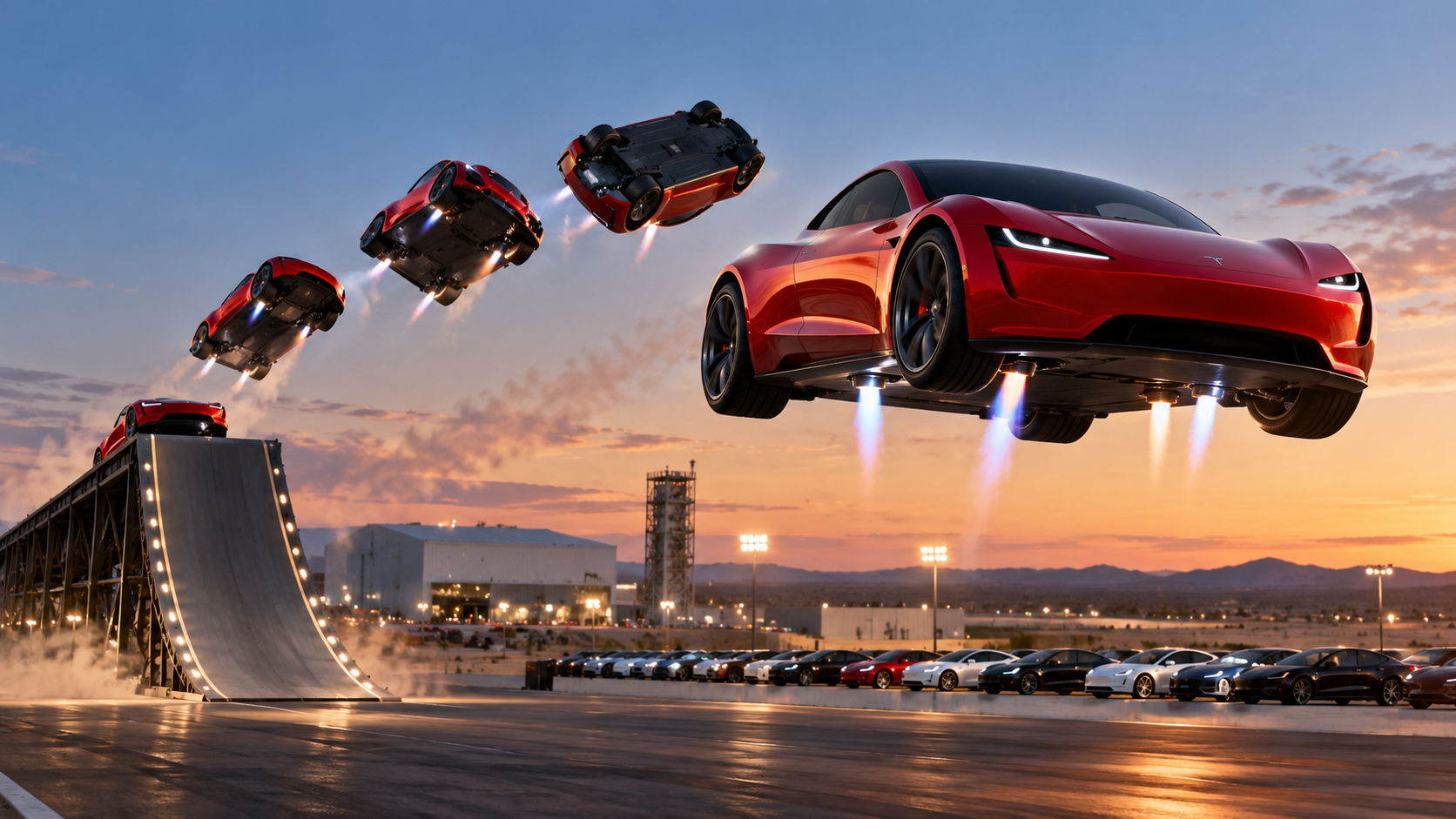
Elon Musk has once again captured global attention with a dramatic demonstration of Tesla’s next-generation Roadster. The electric sports car was shown climbing a specially designed ramp, travelling upside down, briefly taking to the air, performing a mid-air manoeuvre and landing safely during a demonstration in Texas.
The showcase, held at a SpaceX facility near McGregor, Texas, on October 15, 2026, has sparked fresh discussions about the future of electric vehicles and the possibility of combining automotive engineering with aerospace technology.
However, the demonstration also raises important questions about safety, practicality and whether such technology could eventually become available in production vehicles.
What Happened During Tesla’s Flying Car Demonstration?
The demonstration featured a redesigned Tesla Roadster performing a series of unusual manoeuvres that went far beyond conventional electric-car capabilities.
The vehicle accelerated up a purpose-built curved ramp, travelled upside down along part of the structure and then briefly lifted into the air. It performed an aerial rotation before returning to the ground in a controlled landing.
The event attracted attention because the Roadster appeared to combine the performance characteristics of an electric supercar with technology inspired by rocket propulsion.
While the demonstration was visually impressive, it took place in a controlled environment. It does not establish that the vehicle can safely fly over ordinary roads or operate like a conventional aircraft.
How Does the Flying Tesla Technology Work?
The reported technology combines Tesla’s electric-vehicle engineering with aerospace-inspired systems developed in collaboration with SpaceX.
SpaceX-Inspired Thrusters
According to reports covering the demonstration, the Roadster uses cold-gas thrusters that release pressurised gas to generate thrust. Unlike conventional rocket engines, this type of system does not depend on combustion to produce its thrust.
Carefully directed bursts of gas can generate forces that help a vehicle lift briefly from the ground or adjust its orientation during an airborne manoeuvre.
The exact performance limits, control systems and operational safety requirements of the demonstrated technology have not been fully established publicly.
How Did the Car Travel Upside Down?
The upside-down sequence involved a specially designed curved structure and a reported suction-based system that helped the vehicle remain attached to the surface.
This is an important distinction: driving upside down on a purpose-built track is not the same as flying freely through the air. The two manoeuvres involve different engineering challenges and safety considerations.
Can It Really Fly Like an Aircraft?
The demonstration showed that the prototype could perform a short airborne manoeuvre. It did not demonstrate the capabilities required for routine passenger flights, such as sustained flight, practical navigation, reliable emergency systems and operation in changing weather conditions.
For now, the term “flying Tesla” is best understood as a description of an experimental vehicle demonstration rather than a conventional flying car.
Tesla Roadster: Performance and Expected Production
The next-generation Roadster has been anticipated since Tesla first unveiled its original concept in 2017. The project has experienced a lengthy development period, with its production timeline changing over the years.
The latest demonstration has renewed interest in the vehicle and its potential performance.
Tesla and Elon Musk have made ambitious claims about the Roadster’s acceleration and advanced capabilities. However, advertised specifications and demonstration results should be distinguished from independently verified performance in a final production vehicle.
Production is currently expected to begin in 2028, according to reports following the demonstration. This remains a forward-looking timeline, not confirmation that customer deliveries have begun.
Pricing, final specifications, regulatory approvals and the availability of the experimental flying features may change before a production model reaches customers.
Is the Flying Tesla Safe and Legal?
Safety and regulation will be major considerations if Tesla intends to offer any version of this technology commercially.
A vehicle equipped with high-pressure gas systems and capable of leaving the ground would require extensive engineering validation. Manufacturers would need to address passenger protection, system failures, emergency landing behaviour and risks to people nearby.
Road-vehicle regulations would also remain relevant, while any aircraft-like operation could introduce additional legal and regulatory requirements depending on the vehicle’s design and intended use.
A controlled demonstration is only one stage of development. It cannot by itself establish that a vehicle is ready for everyday use.
What Does This Mean for the Future of Electric Vehicles?
The demonstration highlights how electric-vehicle development is increasingly intersecting with software, advanced materials, automation and aerospace engineering.
For Tesla, the Roadster provides an opportunity to showcase ambitious performance technology and reinforce its image as an innovation-focused company. For the wider automotive industry, it demonstrates how unconventional engineering concepts can attract attention and encourage discussion about future mobility.
Nevertheless, the most important measure of success will be whether these technologies can become reliable, affordable and safe enough for customers.
Practical electric vehicles must still deliver dependable performance, useful range, efficient charging, durability and competitive pricing. Experimental flight capabilities may remain a specialised feature rather than a priority for mainstream transport.
Conclusion
Elon Musk’s “flying Tesla” demonstration has delivered a striking glimpse of what experimental automotive engineering may achieve. The next-generation Roadster’s ramp manoeuvre, brief flight, mid-air rotation and safe landing have generated considerable interest in the combination of electric-car technology and SpaceX-inspired thrusters.
Yet major questions remain about commercial readiness, safety, regulations and the final production specifications.
The demonstration is an important technological spectacle, but whether the Roadster will become a practical product with these capabilities depends on further development and validation.
For now, the flying Tesla represents an ambitious experiment at the intersection of electric mobility and aerospace engineering.
Source: https://timesofindia.indiatimes.com/world/us/watch-elon-musks-tesla-unveils-roadster-with-flying-car-like-features/articleshow/134982294.cms