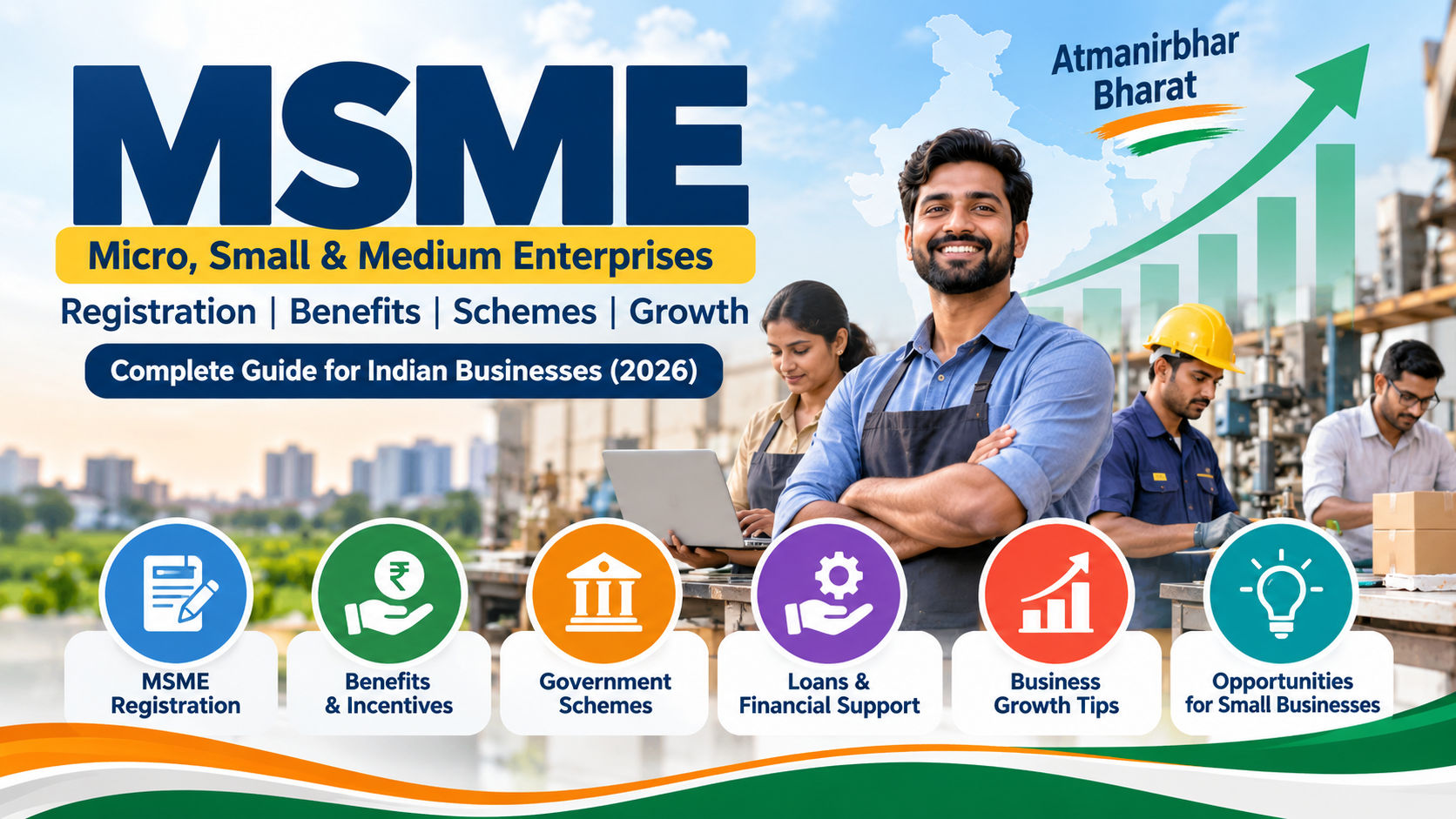
Micro, Small and Medium Enterprises (MSMEs) play an important role in India's economic growth. They support entrepreneurship, generate employment, contribute to manufacturing and services, and help small businesses participate in domestic and international markets.
From local retailers and manufacturers to IT companies, online sellers and service providers, many businesses can fall under the MSME category if they meet the applicable investment and turnover criteria.
The Government of India provides an official registration system called Udyam Registration to help eligible businesses access applicable government schemes and other benefits. In this article, we explain what MSME means, the latest classification criteria, how to register, the benefits available and how small businesses can grow.
What Is MSME?
MSME stands for Micro, Small and Medium Enterprises . These are businesses classified according to their investment in plant, machinery or equipment and their annual turnover.
MSMEs operate across multiple sectors, including:
- Manufacturing and industrial production
- Wholesale and retail businesses, subject to applicable scheme rules
- Ecommerce and online selling
- Website development and IT services
- Consulting and professional services
- Food processing and local businesses
- Logistics, packaging and distribution
MSME classification helps the government design policies and programmes for businesses of different sizes.
MSME Classification in India 2026
From 1 April 2025, the revised MSME classification limits apply in India. Both investment and annual turnover are considered when determining a business's classification.
| Enterprise Category | Investment Limit | Annual Turnover Limit |
|---|---|---|
| Micro Enterprise | Up to ₹2.5 crore | Up to ₹10 crore |
| Small Enterprise | Up to ₹25 crore | Up to ₹100 crore |
| Medium Enterprise | Up to ₹125 crore | Up to ₹500 crore |
To qualify for a particular category, a business must satisfy both applicable limits. The classification framework applies to manufacturing and service enterprises, subject to the governing rules.
For example, a service business with investment of ₹20 lakh and annual turnover of ₹80 lakh would generally fall within the micro-enterprise limits, assuming the remaining eligibility requirements are met.
What Is Udyam Registration?
Udyam Registration is the official online registration system used by the Ministry of Micro, Small and Medium Enterprises.
Eligible businesses can register through the government portal to obtain a Udyam Registration Number and certificate. The process is designed to be paperless and based on information verified through government databases.
Businesses should use the official website:
https://udyamregistration.gov.in/
Be careful when using third-party websites that charge registration or consultancy fees. The official Udyam registration process is free.
Documents and Information Required for MSME Registration
The Udyam Registration process generally relies on Aadhaar-based verification and linked government records.
Depending on the business structure, applicants may need the following information:
- Aadhaar details of the proprietor or the authorised person, as applicable
- PAN details
- GSTIN, where GST registration is applicable
- Business name and address
- Bank account details
- Business activity and NIC code
- Investment and turnover information, as available through linked records
The exact verification requirements depend on the entity type and applicable rules. Applicants should enter accurate information and follow the instructions on the official portal.
How to Register for MSME Online
Follow these steps to apply for Udyam Registration.
Step 1: Visit the official portal
Open the Udyam Registration website at https://udyamregistration.gov.in/.
Step 2: Select new registration
Choose the option for an entrepreneur who is not yet registered as an MSME.
Step 3: Complete Aadhaar verification
Enter the required Aadhaar information and complete OTP verification.
Step 4: Provide PAN and business details
Enter the relevant PAN, business information, entity type and other requested details.
Step 5: Submit the registration information
Complete the remaining fields and submit the application after checking the information for accuracy.
Step 6: Receive your Udyam details
After successful processing and verification, the registration details and certificate become available through the portal.
Registration does not automatically guarantee a loan, subsidy or approval under every government scheme. Individual programmes may have separate eligibility requirements.
Benefits of MSME Registration
Udyam Registration can help eligible businesses establish their MSME status and access applicable programmes.
1. Access to Business Finance
Eligible MSMEs may apply for business loans from banks and other regulated lenders. Credit guarantee programmes may also support qualifying loans, subject to scheme rules and lender approval.
2. Government Tender Opportunities
Certain government procurement policies provide benefits or preferences to eligible micro and small enterprises. The conditions depend on the procurement policy, tender and enterprise category.
3. Delayed Payment Protection
The MSME Development Act contains provisions relating to delayed payments to qualifying micro and small enterprise suppliers. In eligible cases, buyers are generally required to make payment within the agreed period, which cannot exceed 45 days under the Act.
Businesses should check whether their enterprise and transaction qualify for these protections.
4. Support for Technology and Modernisation
Eligible businesses may benefit from selected government programmes for technology adoption, quality improvement, productivity, testing, certification or modernisation.
5. Support for Market Expansion
Some schemes support eligible enterprises participating in trade fairs, exhibitions, marketing initiatives or export-related activities.
6. Formal Business Recognition
An Udyam certificate can help demonstrate MSME registration status when applying for relevant tenders, schemes or business facilities that require it.
Government Schemes for MSMEs in India
Several government programmes may support eligible small businesses.
Prime Minister's Employment Generation Programme (PMEGP): Supports eligible new micro-enterprise projects through a credit-linked subsidy mechanism, subject to scheme conditions.
Credit Guarantee Scheme for Micro and Small Enterprises: Provides credit guarantee support for eligible lending to micro and small enterprises through participating lenders, according to applicable guidelines.
PM Vishwakarma: Provides specified support to eligible traditional artisans and craftspeople.
Public Procurement Policy for Micro and Small Enterprises: Establishes procurement-related provisions for eligible MSEs under applicable central government purchasing rules.
MSME ZED Certification Scheme: Supports eligible enterprises in adopting quality and environmentally responsible manufacturing practices.
Scheme availability, financial limits, subsidies and eligibility conditions can change. Always verify the latest guidelines on the relevant official government portal before applying.
How MSMEs Can Grow Their Business in 2026
Registration is one step. Sustainable business growth also requires a clear strategy.
Build a Professional Website
A business website can help customers discover products and services, review company information and contact the business directly.
Manufacturers, wholesalers and service providers can use their websites to generate enquiries and establish credibility.
Start Selling Online
Businesses can explore ecommerce websites, online marketplaces and digital catalogues to reach more customers. B2B companies can display product specifications, minimum order quantities and wholesale pricing where appropriate.
Invest in Digital Marketing
Search engine optimisation, local SEO, Google Business Profile, content marketing and paid advertising can help businesses reach relevant customers.
Use Business Software
Accounting software, inventory systems, customer relationship management tools and automated follow-ups can help streamline operations and improve customer service.
Explore Export Opportunities
Eligible MSMEs may explore export promotion resources, trade events and relevant government support programmes to identify international business opportunities.
Conclusion
MSMEs are an important part of India's business ecosystem, supporting entrepreneurship, employment and economic development. The revised classification limits effective from April 2025 have expanded the investment and turnover thresholds for micro, small and medium enterprises.
For eligible businesses, Udyam Registration can help establish official MSME status and provide access to relevant schemes, procurement provisions and other benefits where applicable.
Business owners should register through the official portal, maintain accurate business records and review the latest scheme guidelines before applying for financial or government support.
Disclaimer: This article is for general informational purposes. Confirm current eligibility, registration rules and scheme conditions through official government sources.